
Moving day is stressful enough without a removal crew standing on your doorstep telling you they can’t take the tin of paint under the stairs, the gas bottle in the shed, or the goldfish. Every year, UK households find out the hard way that what items can’t removal companies move is a longer list than they expected.
The good news: none of this needs to catch you out. Every restriction a removal company places on your belongings comes down to one of four things — safety, the law, insurance, or plain practicality — and once you know which bucket an item falls into, planning around it is simple.
This guide covers exactly what UK removal companies won’t move in 2026, what they’ll move but treat differently (pianos and hot tubs, we’re looking at you), and the newest addition to most companies’ restricted list: lithium-ion batteries.
Quick answer: UK removal companies generally won’t move hazardous materials (petrol, paint, gas canisters, fireworks), perishable food, pets, cash, jewellery or important documents. Pianos, hot tubs and antiques aren’t banned — they just need a specialist service. E-bikes and spare lithium-ion batteries increasingly need to be declared in advance too.
In this guide:
- What Items Can’t Removal Companies Move — and Why
- Hazardous & Dangerous Goods No Van Will Carry
- Perishable Food, Plants & Pets
- Cash, Valuables & Important Documents
- Not Banned, Just Specialist: Pianos, Hot Tubs & More
- The 2026 Problem: Lithium-Ion Batteries & E-Bikes
- Full Comparison Table
- Common Mistakes to Avoid on Moving Day
- How Merit Removals Handles Restricted Items
- FAQs
- Conclusion
What Items Can’t Removal Companies Move — and Why
Removal companies don’t turn down items to be difficult. Every UK removal firm works within legal restrictions, insurance conditions, and basic health and safety rules that shape what can travel in the back of a standard moving van.
Most reputable firms — including those affiliated with the British Association of Removers (BAR) — follow a code of practice covering insurance, vehicle standards and staff conduct. On top of that, standard removal vans aren’t licensed or built to the same standard as vehicles covered by the UK’s dangerous goods transport rules — which is where most “won’t move” policies actually come from.
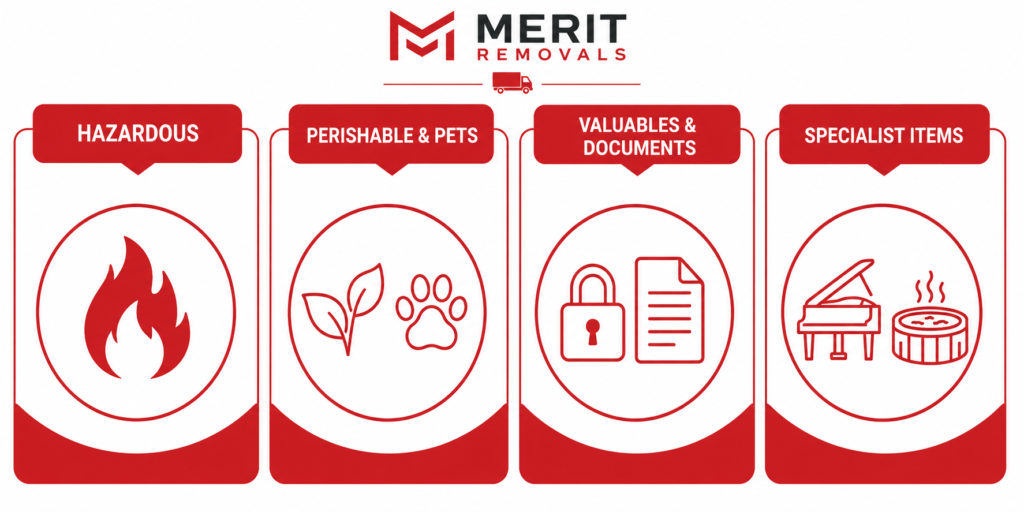
In practice, restrictions fall into four categories:
- Safety and law — items that are illegal or dangerous to carry in a standard van (fireworks, gas cylinders, corrosive chemicals).
- Insurance — items your removal firm’s policy won’t cover, so they ask you to carry them yourself (cash, jewellery, documents).
- Practicality — items that need specialist equipment or training rather than an outright ban (pianos, hot tubs, safes).
- Spoilage and welfare — perishable or living items that can’t survive transit or risk contaminating other belongings (food, plants, pets).
Keep this framework in mind as you read the rest of this guide — it explains why an item is restricted, not just that it is.
Hazardous & Dangerous Goods No Van Will Carry
This is the biggest category — and where the restrictions really come down to fire risk and physics. Standard removal vans are goods vehicles, not licensed hazmat transport, so anything flammable, corrosive, explosive or under pressure is off the list by default.
Flammable liquids and gases
- Petrol, diesel, paraffin and white spirit
- Paint, paint thinner and varnish
- Propane and butane canisters (camping stoves, BBQ gas)
- Aerosols in bulk quantities
- Lighter fuel and matches
Corrosive and toxic substances
- Bleach, drain cleaner and pool chemicals
- Pesticides, herbicides and fertiliser
- Car and motorcycle batteries (acid-based)
Explosives and weapons
- Fireworks and ammunition
- Firearms — these need a separate, licensed transport arrangement, not a standard removal van
Compressed gas cylinders
- Fire extinguishers
- Scuba tanks and oxygen cylinders
💡 Expert tip: Ask your removal company for a written list of excluded items before moving day. Policies vary slightly between firms, and a two-minute email avoids an awkward surprise when the van arrives.
Use up, gift, or dispose of anything on this list through your local council’s household waste site well before your move date — most accept these items free of charge.
Perishable Food, Plants & Pets
Food
Fresh and frozen food is one of the most commonly overlooked exclusions. It’s not dangerous, but it can spoil, leak, or attract pests during a move that might take several hours from loading to unloading.
- Fresh and frozen food (defrost your freezer at least 24 hours before moving day)
- Opened food containers and packets
- Anything requiring refrigeration in transit
Empty fridges and freezers travel fine — it’s just the contents that need to go via cool bag, neighbour, or bin.
Plants
For a local UK house move, most removal companies will still carry sturdy potted plants at your own risk, though delicate or invasive species may be declined. For long-distance or international relocations, plant movement is far more restricted under UK biosecurity rules on pests and soil-borne disease — always check with your removal company if plants are part of the job.
Pets
No UK removal company will transport live animals, full stop. It’s not a policy quirk — it’s animal welfare, driver safety, and common sense. Arrange a separate pet transport service, or have a friend or family member look after pets on moving day itself.
Cash, Valuables & Important Documents
Unlike hazardous items, valuables aren’t dangerous — they’re just uninsurable. Standard removal insurance covers reasonable loss or damage to household goods, not cash, precious metals, or one-of-a-kind documents that can’t be replaced or fairly valued.
- Cash and currency
- Jewellery and precious metals
- Passports, birth certificates, deeds and wills
- Laptops, phones and other high-value electronics (many firms will move these, but check your policy limits first)
- Keys — house, car, safe
- Prescription medication
💡 Expert tip: Pack a single “moving day bag” with everything on this list, plus chargers and a change of clothes, and keep it with you — not in the van — at all times.
Not Banned, Just Specialist: Pianos, Hot Tubs & More
Not everything that turns up in a “won’t move” search result is actually banned. Some items just need the right equipment, training and insurance to move safely — a very different problem to a legal restriction.
- Pianos — upright and grand pianos need specialist trolleys, ramps and often more than two movers to shift safely without damaging the instrument, your floors, or your walls. See our piano removal service for how we handle these.
- Hot tubs — these need draining, disconnecting and lifting with the right rigging, not a job for a standard two-person crew. Our hot tub removal service covers the full process, from drain-down to reinstallation.
- Pool tables and safes — heavy, awkward, and easy to damage a staircase with if handled wrong.
- Antiques and fine art — need bespoke packing materials, not standard cardboard.
- Grandfather clocks — the mechanism usually needs locking or removing before transit.
If any of these are on your inventory, mention them when you book your removal service rather than on the day — it changes the crew size, equipment, and sometimes the vehicle needed.
The 2026 Problem: Lithium-Ion Batteries & E-Bikes
Older guides to what removal companies won’t move don’t mention this yet, but most reputable UK firms have added a newer category to their exclusions in the last couple of years: lithium-ion batteries.
E-bikes, e-scooters and their batteries have become one of the fastest-growing fire risks in UK homes and vehicles. A 2026 insurance industry report found UK fire services are now tackling a lithium-ion battery fire roughly every five hours, with e-bike fires alone more than tripling since 2022. A damaged or poor-quality battery can ignite within seconds and is notoriously hard to put out — the last place you want that happening is inside a loaded moving van.
Because of this, many removal companies now ask customers to declare:
- E-bikes and e-scooters (especially converted or non-certified models)
- Spare or removed lithium-ion batteries
- Power tool battery packs in bulk
- Large power banks
This doesn’t always mean an outright refusal — some firms will move certified, undamaged e-bikes with the battery removed and packed separately. But it’s exactly the kind of item to flag when booking, not discover on the day.
Full Comparison Table: Can, Can’t, or Specialist?
| Item | Can a removal company move it? | What to do instead |
|---|---|---|
| Petrol, paint, solvents | No | Use up or dispose of at a household waste site |
| Gas canisters (propane/butane) | No | Return to supplier or dispose of safely |
| Fireworks & ammunition | No | Use, gift, or hand in to a licensed collector |
| Fresh/frozen food | No | Eat, donate, or transport yourself in a cool bag |
| Pets | No | Book separate pet transport |
| Houseplants (international move) | Usually not | Gift, sell, or carry yourself for local moves |
| Cash & jewellery | No | Carry with you personally |
| Important documents | Not recommended | Keep in hand luggage or your car |
| Pianos | Yes — specialist service | Book a piano removal specialist |
| Hot tubs | Yes — specialist service | Book a hot tub removal specialist |
| E-bikes & lithium batteries | Depends — ask first | Declare in advance; battery may need separate packing |
Common Mistakes to Avoid on Moving Day
- Hiding restricted items in boxes. If a crew finds an undeclared gas canister or aerosol mid-load, they’re required to pull it out on the spot — delaying everyone and potentially voiding your insurance for that item.
- Assuming every company has the same rules. One firm’s “won’t move” list isn’t universal. Always check with the company you’ve actually booked.
- Leaving it until moving day to mention a piano or hot tub. These need to be quoted and crewed for in advance, not discovered on arrival.
- Packing valuables in with general boxes. If cash or jewellery goes missing from an unlabelled box, most policies won’t cover it.
- Forgetting to declare e-bikes or spare batteries. Given the current fire risk, this is quickly becoming a standard question on every quote form.
Quick pre-move checklist
- ☐ Use up or dispose of flammable liquids and gas canisters
- ☐ Defrost the freezer and clear the fridge
- ☐ Arrange separate transport for pets
- ☐ Pack a “keep with me” bag for cash, documents and medication
- ☐ Declare pianos, hot tubs, or other specialist items when booking
- ☐ Flag any e-bikes or spare lithium batteries
- ☐ Ask your removal company for their written exclusions list
How Merit Removals Handles Restricted Items
At Merit Removals, we’d rather flag a restricted item at the quote stage than at the kerb. When you book our removals service, we’ll talk you through exactly what we can take, what needs a specialist visit (like a piano or hot tub), and what you should keep with you personally.
Specialist items are quoted separately since they affect crew size and equipment — check our pricing page for a clear breakdown before you commit to a date.
FAQs
Can removal companies move paint tins?
No. Paint and paint thinner are flammable and appear on almost every removal company’s excluded list. Use up or dispose of them at a household waste site before moving day.
Will movers take my houseplants?
For a local UK move, most removal companies will carry sturdy potted plants at your own risk. For long-distance or international moves, biosecurity rules make this far more restricted — check with your removal company first.
Can I put cash or jewellery in the moving van?
You can, but you shouldn’t. Removal insurance excludes cash, jewellery and precious metals, so any loss wouldn’t be covered. Carry these with you personally.
Do removal companies move pianos?
Yes, but as a specialist job rather than part of a standard move — pianos need dedicated trolleys, ramps and experienced crew, so mention it when you book.
Can a hot tub be moved with the rest of my furniture?
Not by a standard crew. Hot tubs need draining, disconnecting and specialist lifting, so they’re booked as a separate service.
What happens if a crew finds a banned item in my boxes?
They’re required to remove it from the van on the spot for safety reasons, which can delay your move. It’s always better to declare restricted items in advance.
Can removal companies move e-bikes or spare batteries?
It depends on the company and the battery’s condition. Given the rise in lithium-ion battery fires, most firms now ask you to declare e-bikes and spare batteries at booking rather than assuming they’re fine.
Do I need to empty my fridge and freezer before the move?
Yes. Defrost and empty both at least 24 hours before moving day — the empty appliance can travel, but the food inside can’t.
Can removal companies transport pets?
No. UK removal companies never transport live animals — arrange separate pet transport or have someone look after them on the day.
Is the restricted items list the same for every removal company?
No. There’s a common core (hazardous materials, pets, cash), but the details vary by firm. Always ask your removal company for their written list of exclusions before booking.
Conclusion
Knowing what items can’t removal companies move before moving day saves you last-minute scrambling, delays, and the odd argument on the doorstep. Most restrictions come down to safety, insurance, or specialist handling rather than arbitrary rules — and once you’ve cleared your hazardous items, packed your valuables separately, and flagged anything unusual (piano, hot tub, e-bike) at the quote stage, the rest of your move should run smoothly.
Ready to book your move? Get a clear, upfront quote from Merit Removals — including honest guidance on anything that needs specialist handling. Check our pricing to see what’s included.