
Somewhere between wrapping the last plate in newspaper and handing over the keys, most people hit the same wall: what do you actually do with the fridge? A house move forces you to deal with every large appliance you own — the washer, the dryer, maybe an American-style fridge freezer that will not fit through the new kitchen door — and most people never work out how to dispose of old appliances when moving until it is already moving week.
Here is the part that catches people out: you cannot just leave a fridge on the pavement or tell the new owners to “sort it out.” In the UK, old appliances fall under the WEEE Regulations, and getting rid of them the wrong way can mean a fixed penalty notice, a fly-tipping investigation, or a removal firm that refuses to touch a leaking fridge freezer on the day.
This guide covers exactly how to dispose of old appliances when moving: what the law actually requires, which options are free, which cost money, and how to handle fridges, washing machines and dryers specifically so moving day does not grind to a halt over a 15-year-old tumble dryer.
Quick Navigation
- Why You Cannot Just Bin an Old Appliance
- Your Legal Options for Disposing of Old Appliances When You Move
- How to Get Rid of Specific Appliances (Fridges, Washers, Dryers & More)
- Moving Out of a Rented Property? What Tenants Need to Know
- Common Mistakes to Avoid
- Your Pre-Move Appliance Disposal Checklist
- Frequently Asked Questions
Why You Cannot Just Bin an Old Appliance
Every fridge, washing machine and dryer sold in the UK is classed as WEEE — Waste Electrical and Electronic Equipment — under the Waste Electrical and Electronic Equipment Regulations 2013. These rules exist because appliances like these hold two things general waste trucks are not built to handle: hazardous substances (refrigerant gases, wiring, small amounts of oils) and genuinely valuable recoverable materials (steel, copper, aluminium). Putting either through a bin lorry or a compactor either releases the hazardous stuff or destroys the value that would otherwise be recovered.
The regulations also work on a principle called Extended Producer Responsibility: the businesses that manufacture and sell electrical goods are made financially responsible for collecting and recycling them once you are done with them, rather than leaving the cost to local councils and taxpayers. That is why, as you will see below, retailers have specific legal duties when you buy a replacement appliance.
What Counts as WEEE When You Are Moving House?
If it has a plug, a cable or a battery, it is almost certainly covered. For a house move, the appliances that matter most are:
- Fridges and freezers, including American-style fridge freezers
- Washing machines and washer-dryers
- Tumble dryers (vented and condenser)
- Dishwashers, cookers and built-in ovens
- Microwaves, kettles and other small kitchen electricals
The Crossed-Out Wheelie Bin Symbol
Look on the back or base of almost any appliance and you will find a small icon of a wheelie bin with a cross through it. That is the official WEEE mark, and it means exactly one thing: this item must not go in general household waste. It has to be collected separately and sent for proper treatment.
Your Legal Options for Disposing of Old Appliances When You Move
There is no single “correct” way to dispose of old appliances when moving — the right option depends on whether you are buying a replacement, how much time you have before completion day, and whether the appliance still works. Here are the six routes that are actually legal in the UK, in the order most people find useful.
Option 1: Retailer Takeback (If You Are Buying a Replacement)
If you are ordering a new fridge, washing machine or similar appliance around the time of your move, the retailer is legally required to help you get rid of the old one — free of charge — as long as it is a like-for-like swap (old fridge for new fridge, not old fridge for a new microwave). This is usually arranged in one of three ways: handed over in-store, collected when the new appliance is delivered, or organised through the industry-wide Distributor Takeback Scheme.
In practice, most retailers give you a window of around 28 days from your receipt to hand over the old item, and it does not always have to be the exact shop you bought from. Always confirm the process directly with the retailer before delivery day, since arrangements vary between companies and are being expanded under ongoing government reforms through 2026. You can read the official rules on retailer and distributor responsibilities for electrical waste on GOV.UK.
Option 2: Household Waste Recycling Centre (HWRC)
If you can transport the appliance yourself, most council-run recycling centres accept household WEEE completely free. The catch on a moving day is practical, not legal: a fridge freezer is heavy, awkward, and not something most people can safely lift into a hatchback. Some centres also ask you to book a slot in advance or bring proof of address, and not every site takes fridges or freezers, so it is worth checking your specific centre before you load the car.
Option 3: Council Bulky Waste Collection
Most councils will collect large appliances directly from your home for a fee, commonly somewhere in the £15–£60 range depending on the area, with some councils offering free or reduced-cost collections for residents on certain benefits. This is the option most people reach for when moving, but it needs to be booked well ahead of completion day since slots fill up quickly around weekends and month-ends. You can find your council’s exact service through the official large waste item collection finder on GOV.UK. Note that many councils will not collect a fridge or freezer if there is still food inside it.
Option 4: Donate, Sell or Give Away (If It Still Works)
A working appliance in reasonable condition does not have to be “waste” at all. Local charities, reuse networks, Freecycle, Freegle and Facebook Marketplace are all realistic homes for a fridge or washing machine that still does its job — and it saves you a collection fee. Some charities will only take electrical items that have passed a basic electrical safety (PAT) test before collection, so it is worth asking first rather than turning up with it unannounced.
Option 5: A Scrap Metal Collector
Because large appliances are mostly steel, some local scrap metal merchants will collect them free of charge, or even pay a small amount, purely for the metal value. If you go this route, make sure the collector is a registered waste carrier — a legitimate operator will have no problem confirming this, and it protects you if the item is later found dumped illegally.
Option 6: A Professional Removal Company (the Moving-Day Shortcut)
The option most people end up preferring once they realise how much coordination the others take: a removal company that can take unwanted appliances away in the same visit as your move. Instead of booking a council slot, driving to the tip, and hoping a charity van turns up before completion day, one licensed team clears the old appliances while they are already on site moving everything else.
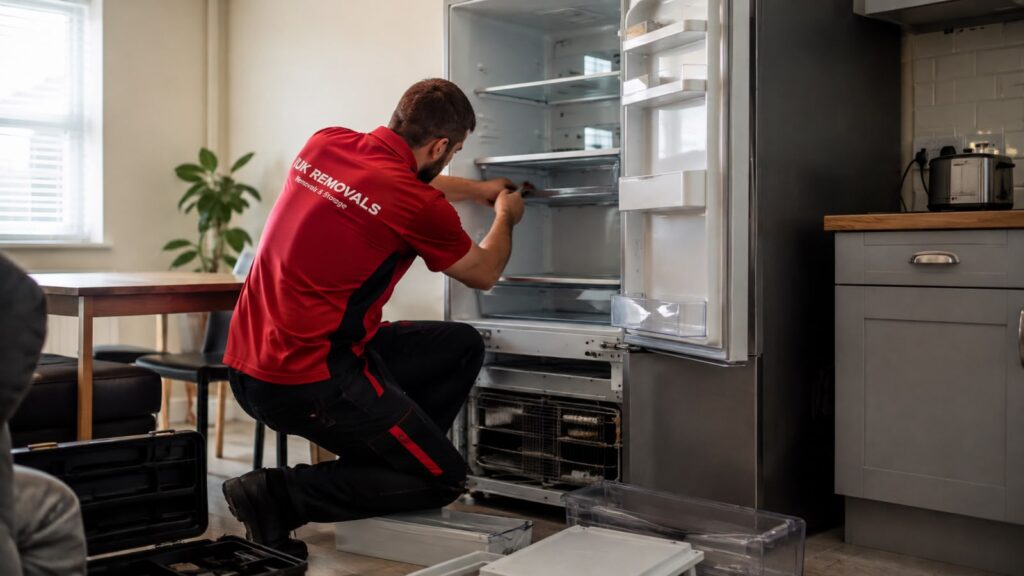
The one thing worth checking here is the same thing that applies to a scrap collector: the company should hold a genuine waste carrier’s licence from the Environment Agency, so your appliances are actually recycled rather than fly-tipped in your name. Merit Removals’ appliance removal service is built around exactly this — a team that comes into the house, collects fridges, washing machines, dryers, dishwashers and cookers, and takes care of disposal properly, so it is one less thing to schedule around your move.
How to Get Rid of Specific Appliances When You Move
The general rules above apply to every large appliance, but a few need their own preparation before collection day.
Fridges and Freezers (Including American-Style Models)
Fridges and freezers get their own strict handling rules for one reason: refrigerant gas. It sits both in the cooling circuit and, in most models, in the foam insulation packed into the walls. That gas has to be recovered — “degassed” — at a licensed treatment facility before the appliance can be safely broken down. It is also why a fridge cannot go in a skip: skips are emptied mechanically at the tip, which crushes the unit and vents the gas exactly the way the rules are designed to prevent.
A few things make collection day smoother:
- Defrost the fridge or freezer 24–48 hours beforehand and remove all food
- Wipe out the interior so the collection team is not dealing with spoiled food
- Never transport it lying on its side — this can let compressor oil run into the cooling circuit. If it has been laid down, stand it upright for 24 hours before it is next plugged in
- Leave the door slightly ajar while it is waiting for collection, to stop mould building up
Fly-tipping a fridge or freezer is a criminal offence, not just a fine on paper — fixed penalty notices typically start at around £400, with prosecutions carrying considerably more. For a large American-style fridge freezer specifically, the size and weight usually rule out DIY transport entirely, which is where a dedicated American fridge freezer removal service earns its keep — the team handles the disconnection, the lifting and the safe transport in one go.
Washing Machines
A washing machine is deceptively heavy once you add the concrete counterweights most models use to reduce vibration, and it will still hold residual water in the drum and hoses even after a final spin. Drain and disconnect the hoses fully before moving day — a machine that leaks in the back of a van is a mess nobody wants to clean up. Once collected, the steel drum and casing are among the most efficiently recycled parts of any appliance. If lifting and disconnecting one safely is not something you want to attempt alone, Merit Removals’ washing machine removal service covers the disconnection and the heavy lifting.
Tumble Dryers
Whether you have a vented or condenser dryer, empty the lint filter (and the water tank, on a condenser model) before it is moved. A dryer that has been sitting full of lint in storage for months is a genuine fire risk, so this is worth doing even if the appliance is not being collected immediately. Beyond that, dryers follow the same disposal routes as any other large WEEE item — retailer takeback, HWRC, council collection, or a specialist dryer removal service if you would rather it was someone else’s problem on moving day.
| Appliance | General waste bin? | Main hazard | Best disposal routes |
|---|---|---|---|
| Fridge / freezer | No — banned under WEEE rules | Refrigerant gas in circuit & foam | Retailer takeback, HWRC, council collection, removal company |
| American fridge freezer | No | Larger refrigerant volume, weight | Specialist large-appliance removal, retailer takeback |
| Washing machine | No | Residual water, weight | HWRC, council collection, scrap collector, removal company |
| Tumble dryer | No | Lint fire risk if stored | HWRC, council collection, removal company |
| Dishwasher / cooker | No | Electrical components | Retailer takeback, HWRC, council collection |
| Small electricals (kettles, toasters) | No | Minor — batteries/wiring | In-store takeback bins, kerbside WEEE collection, HWRC |
Moving Out of a Rented Property? What Tenants Need to Know
The duty to dispose of an appliance properly does not go away just because you are renting. Under the Environmental Protection Act 1990, anyone who dumps or abandons waste — including leaving an old appliance behind without arrangement — can be held responsible for it, tenant or not.
Before move-out day, check your tenancy agreement or inventory to see which appliances belong to the landlord and which are genuinely yours. If an appliance is yours to remove, agree the timing with your landlord or agent in advance. Leaving an unwanted appliance behind “for the landlord to deal with” without that agreement is a common cause of deposit deductions, and in some cases can be treated as fly-tipping if it is dumped outside rather than left inside the property with permission.
If in doubt, put it in writing. A short message confirming which appliances you are taking and which are staying protects both you and your deposit.
Common Mistakes People Make When Disposing of Appliances on a Move
- Assuming the new owner or tenant will “just deal with it.” Always confirm in writing what is included in the sale or tenancy — unwanted appliances left without agreement can hold up completion.
- Leaving a fridge sealed shut for days before collection. This causes mould and odour. Leave the door slightly open once it is empty and defrosted.
- Putting small electricals in the general bin. Kettles, irons and toasters are WEEE too — most large supermarkets and DIY stores have a small-electricals takeback bin near the entrance.
- Booking a council collection too late. Bulky waste slots and HWRC booking windows fill up fast around weekends, so book as soon as your moving date is confirmed, not the week before.
- Transporting a washing machine without draining it first. A few litres of leftover water in the drum and hoses will find its way out somewhere you do not want it to.
- Leaving items on the pavement “for the council to grab.” Without a booked, confirmed collection, this counts as fly-tipping and can lead to a fixed penalty notice.
Your Pre-Move Appliance Disposal Checklist
- Decide, for each large appliance, whether it is coming with you, being sold, donated, or recycled
- If buying replacements, ask the retailer about their takeback process before delivery is booked
- If using the council, book your HWRC slot or bulky collection as early as possible
- If using a removal company, confirm appliance removal is included or add it to your quote
- Defrost fridges and freezers 24–48 hours before moving day and remove all food
- Drain and disconnect washing machine and dishwasher hoses
- Empty the lint filter and water tank on tumble dryers
- Get written confirmation of what is included if appliances are staying at the old property
- Keep any collection receipt or confirmation — it is your proof of legal disposal if questions ever come up
Frequently Asked Questions
Can I put an old fridge or washing machine in my general waste bin?
No. Both are classed as WEEE under UK law and must be collected separately from general household waste, either through retailer takeback, a recycling centre, a council collection, or a licensed removal company.
What does the crossed-out wheelie bin symbol actually mean?
It is the official WEEE mark found on almost every electrical item sold in the UK. It tells you the item must not go into general waste and needs to be recycled through a proper collection route instead.
Will the shop take away my old appliance for free when I buy a new one?
In most cases, yes, as long as it is a like-for-like swap. Retailers are required to offer a free takeback option, though the exact process (in-store, on delivery, or via a scheme) varies, so confirm it with them before your new appliance arrives.
Can I just leave my old appliances behind for the new owners?
Only if it is agreed in writing as part of the sale. Anything left without agreement can delay completion, cause disputes, or count as abandoned waste that comes back to you.
Is it illegal to leave an old fridge on the street or in a skip?
Yes. Leaving it on the street without a booked collection is fly-tipping, and most skip companies will refuse fridges outright because emptying a skip mechanically ruptures the appliance and releases refrigerant gas.
How do I dispose of a large American-style fridge freezer?
The same rules apply as a standard fridge freezer, but the size and weight usually make DIY transport impractical. A specialist large-appliance removal service is generally the most practical route.
What actually happens to the gas inside my old fridge or freezer?
It is extracted — “degassed” — at a licensed treatment facility under controlled conditions before the metal, plastic and compressor are recycled. This has to happen before the unit is crushed or broken down.
Can I sell or donate an appliance that still works?
Yes, and it is often the best option if the appliance is in good condition. Charities, reuse networks and online marketplaces are all realistic routes, though some charities require it to pass a basic electrical safety check first.
How much does it cost to have old appliances removed when I move?
It depends on the route. Council bulky collections commonly fall somewhere in the £15–£60 range, HWRCs are typically free if you can transport the item yourself, and a removal company’s cost depends on how many items and how much access is involved — most will quote this alongside your moving costs.
Can a removal company take my old appliances away on moving day?
Yes, provided they hold a genuine waste carrier’s licence. This is usually the easiest option on a move, since the same team handling your furniture can clear unwanted appliances in the same visit rather than you arranging a separate collection.
Key Takeaways
Getting rid of old appliances when you move is not complicated once you know the routes available: retailer takeback if you are replacing like-for-like, a recycling centre or council collection if you are not, donation if the item still works, and a licensed removal company when you would rather it was handled alongside the move itself. What matters most is booking early and never leaving an appliance without a confirmed collection.
If moving day is already close and appliance disposal is the one thing left unplanned, that is exactly the gap a professional team fills. Get a free quote from Merit Removals and have your fridge, washer and dryer collected, recycled and off your hands on the same day as your move — no separate tip run required.